Play Yin-Yang Online
Fill every cell with a black or white circle. Both colours must form a single connected group and no 2×2 area can be all one colour. Five grid sizes and three difficulty levels.
Created by Brian Hamilton
Click a cell to place a circle
How to play Yin-Yang
Colour every cell dark or light, following two rules.
- All dark cells must form one connected group, and all light cells must form one connected group (edges only, not diagonals).
- No 2×2 block may be entirely one colour.
- The cells already coloured cannot be changed.
- Every puzzle has exactly one solution and needs no guessing.
Controls: click a cell to cycle it through dark, light and empty.
The two-by-two rule is doing most of the work
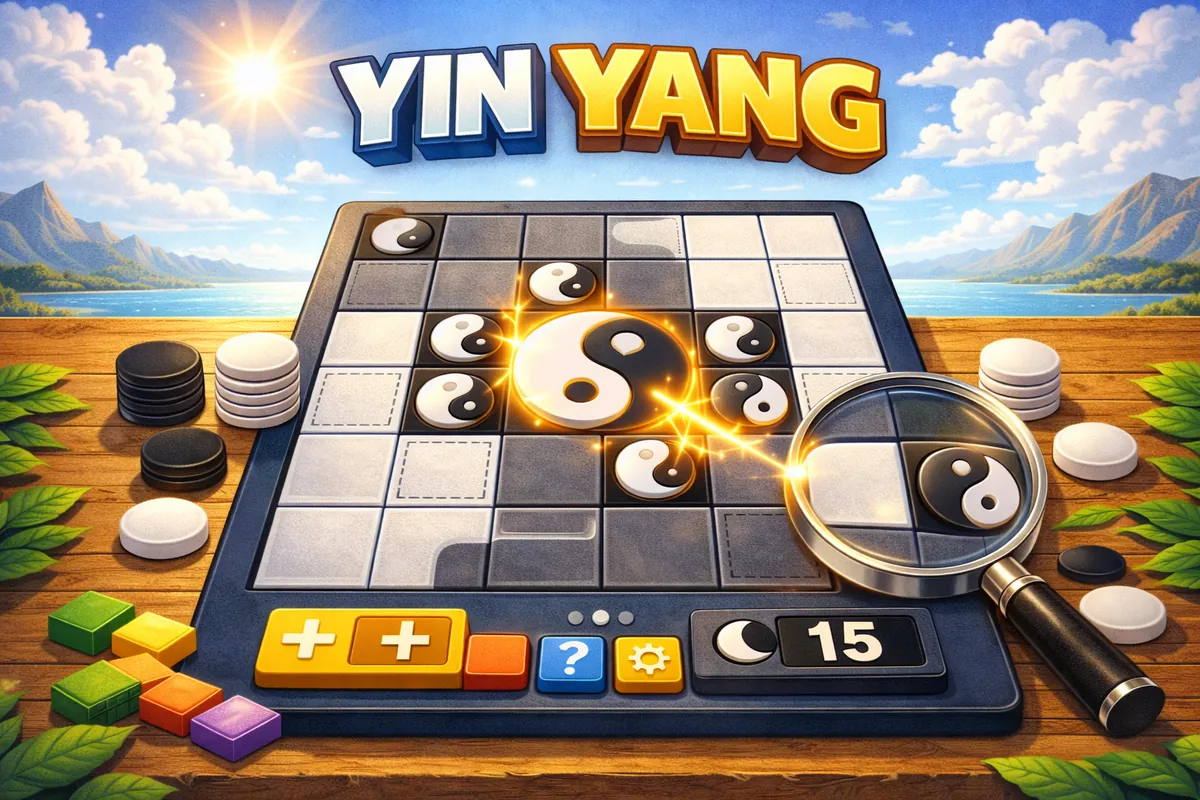
Yin-Yang has two constraints, and they feel very different in weight. One says every dark cell must connect to every other dark cell, and the same for the light ones. The other just says no 2×2 block may be a single colour. The connectivity rule sounds like the important one. In practice the small rule is where nearly every move comes from.
The reason is arithmetic. A 2×2 block has sixteen colourings and only two are banned, so the rule looks weak — but the board is covered in overlapping blocks, and each one is watching four cells at once.
Across 64 generated boards and 3,392 blocks, 58% of every 2×2 block in the finished solution is a three-to-one split. That is what makes the rule bite: in more than half of all blocks, three cells agreeing is enough to settle the fourth.
So the productive sweep is to run your eye over 2×2 windows looking for three cells of the same colour, then colour the fourth. Each one you place creates new windows with three filled, and the board tends to unzip in chains rather than one cell at a time.
Connectivity is a rule about what you cannot do
The connectivity requirement rarely tells you to place a cell. It tells you which placements are forbidden, and that is a different way of thinking.
Two uses are worth learning. First, a cell that would seal a colour off is wrong — if colouring a cell dark would leave a light cell with no light route to the rest, that colour is impossible, so the cell must be light. Second, a colour reaching for a corner has one road: an isolated cell in a corner region must connect through its single opening, which forces the cells along the way.
Both constraints also pull against each other, which is what makes the puzzle satisfying: the 2×2 rule stops either colour forming a solid mass, and connectivity stops either colour fragmenting. Every solution is a pair of interlocking, winding regions — which is why the finished grids look the way they do, and where the puzzle gets its name.
A worked board
Notice that the two colours come out close to even — measured across those 64 boards, the dark cells averaged 49% of the grid. That is not a rule, but it is a useful sanity check: if one colour is running away with the board, something has gone wrong.
Where solvers get stuck
Chasing connectivity too early. On a mostly empty grid, connectivity arguments are hard to make and easy to get wrong. Exhaust the 2×2 deductions first; connectivity becomes far more powerful once the board is half filled and the regions have shape.
Forgetting the rule applies to both colours. It is easy to scan for three darks and miss three lights sitting in the same window. Every block constrains both ways.
Colouring a cell that strands a single cell. The commonest connectivity error is leaving one cell of a colour cut off in a corner. Before committing near an edge, check that the colour you are not placing still has a route out.
Two things you can check about these puzzles
Every puzzle has exactly one solution, and can be reached by logic. The board starts fully coloured, and cells are removed one at a time — a removal is kept only when a propagation solver can deduce that cell back with the correct colour, and put straight back otherwise. That is a stronger test than uniqueness: it means the board can actually be reasoned out. 36 boards across every size and difficulty were re-checked against a separate, exhaustive counter written from the rules alone; all 36 had exactly one solution.
Difficulty is simply how much is left showing. The grid and the rules are identical at every setting — a Hard board is not a stranger pattern, just the same kind of pattern with less of it given away.
| Board | Easy | Medium | Hard |
|---|---|---|---|
| 6×6 cells given | 74% | 55% | 32% |
| 8×8 cells given | 74% | 54% | 33% |
| Dark share of solution | 48% | 48% | 51% |
Yin-Yang and its relatives
Yin-Yang is also published as Shiromaru-Kuromaru, and sometimes as Black and White. It is a young puzzle compared with the Nikoli classics, and it borrows one rule from each of two older ones.
The connectivity requirement is Nurikabe's, except that here both colours must connect rather than just the sea. The two-colour grid is Takuzu's, except that Takuzu counts along lines while Yin-Yang cares about shape. Combining them gives a puzzle with no numbers at all — unusually for a logic puzzle, there is nothing on the board to read.
More two-colour puzzles
If you like deciding which cells are which colour, try these: