Play Reversi Online
The classic disc-flipping strategy game — also known as Othello. Place your discs to outflank and flip your opponent's pieces. Challenge the AI or play with a friend.
Created by Brian Hamilton
How to play Reversi
Trap your opponent's discs between two of yours to flip them, and finish with more discs than they have.
- A move is legal only if it flips at least one disc: it must trap an unbroken run of the opponent's between your new disc and one you already own.
- Runs flip in every direction at once — along rows, columns and diagonals.
- If you have no legal move you pass, and your opponent moves again.
- The game ends when neither side can move. Most discs wins.
- Corners can never be flipped. The squares beside and diagonally inside them are how corners get given away.
Controls: tap or click any highlighted square to play there. Choose the AI difficulty, or two-player mode, above the board.
Ahead on discs and still losing? Use the Reversi best move calculator — set up any position and it will show you the best move plus the breakdown of corners, mobility and frontier discs that the disc count hides.
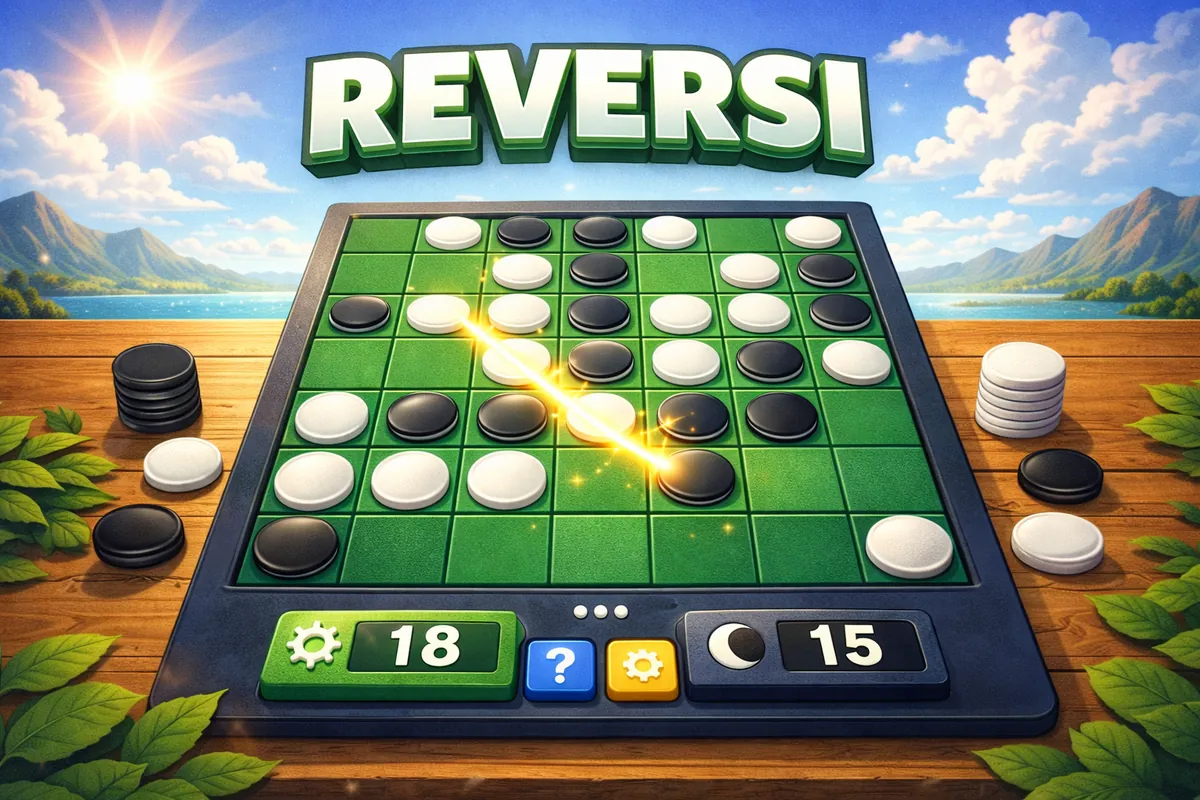
Being ahead on discs means almost nothing
The most natural way to play Reversi is to take the move that flips the most discs. It is also close to the worst. Every disc you flip can be flipped back, right up until the board is full — so a lead built in the opening is not a lead, it is a target.
Playing out full games and recording who was ahead at each stage: with twenty discs on the board, the side in front went on to win 48% of the time. That is not a small edge. It is worse than a coin flip. Even at forty discs — two-thirds of the way through — it is 51%.
Corners are the only permanent thing on the board
A disc flips when it is caught between two of the opponent's, in a line. A corner has no square beyond it on either side, so it can never be caught, and it can never be flipped. It is the only square on the board with that property.
The measurement matches the folklore exactly: across the same games, the side holding more corners at the end won 87% of the time — against 48% for the side leading on discs early. If you take one thing from this page, it is that the disc counter at the top of the screen is telling you almost nothing until very late, and the four corners are telling you almost everything.
The squares that give corners away
Corners are rarely taken by force. They are given away, by playing one of the squares that guards them.
The X-squares are the four squares sitting diagonally inside each corner. Playing one puts your disc on the diagonal leading straight to the empty corner — which is precisely the line your opponent needs to be able to play there. An X-square move with the corner still empty is the single most expensive mistake in the game.
The C-squares are the eight squares beside each corner along the edges. They are less immediately fatal but work the same way: they open a line to a corner you cannot then defend.
Both stop being dangerous the moment the corner they guard is occupied. Until then, treat all twelve as squares you play only when you have run out of anything better — which, as it happens, is exactly the position you are trying to put your opponent in.
Give discs away on purpose
Since flipping is temporary and options are not, the currency that matters is mobility: how many legal moves you have compared with your opponent. A player with two legal moves is choosing between two bad ideas. A player with twelve is choosing.
This produces the strategy that feels wrong to every beginner: flip as few discs as you can. Fewer of your discs on the board means fewer of them sitting on the frontier next to empty squares, which means fewer places your opponent is able to play. Keeping your discs clustered in the middle while your opponent's spread outward is how you end up with all the options in the middlegame — and how you force them to hand you a corner because they have nothing else left.
The endgame reverses it. Once the board is nearly full there are no more options to win, and the disc count becomes the whole game. That is the switch the numbers above show: 51% at forty discs, 68% at fifty.
Where players go wrong
Taking the biggest flip. The move that flips eight discs usually puts eight of your discs on the frontier, handing your opponent eight new places to play.
Playing an X-square early. Worth repeating because it decides games: with the corner empty, that move is close to resigning it.
Panicking at a deficit. Being down 8–24 at move twenty is frequently a winning position. If your opponent has spread themselves across the board to get there, they are the one running out of moves.
Forgetting that passing exists. If you have no legal move you must pass, and your opponent moves again. Manufacturing that situation — leaving them with nothing safe to play — is how corners actually change hands.
What was verified on this page
The rules were checked against an independently written implementation across 1,200 positions reached by random legal play: every flip, on every square, for both colours, plus the legal-move lists, the result of applying a move, the disc counts, and the two conditions that are easy to get wrong — when a player must pass, and when the game is actually over.
One real defect was found and fixed. When the search reached the end of a game it scored the finished position with its ordinary judgement — corners, mobility, frontier, position — instead of simply counting the discs. But a finished game has no future to judge: the only thing that matters is who has more. The effect was that the engine could prefer a good-looking loss to an untidy win. Testing against a solver that plays out every continuation exactly, it threw away 5 winnable endgames out of 120. It now recognises a finished game as a result rather than a position, and gets all 120 right.
The difficulty settings were then played head to head, with both sides taking turns to move first. The labels mean what they say.
| Matchup | Deeper side wins | Loses | Draws |
|---|---|---|---|
| Hard (6 ply) vs Medium (4) | 24 | 0 | 0 |
| Medium (4 ply) vs Easy (2) | 24 | 0 | 0 |
| Hard (6 ply) vs Easy (2) | 24 | 0 | 0 |
Reversi, Othello, and a game with two histories
The game was invented in England in the 1880s — there was a brief dispute over which of two men had done it — and then largely forgotten. It was reintroduced in Japan in 1971 under the name Othello, with the fixed starting position and the standard board it has now. Reversi originally let players place their first four discs where they liked.
It has since become a favourite proving ground for game AI, for a specific reason: the disc count is such a poor guide that a program which naively maximises it plays terribly. It rewards exactly the kind of positional judgement that is hard to write down — which is why the fix described above mattered, and why an engine can look reasonable for fifty moves and still throw the game away on the last one.
More games like this
If you like games decided by position rather than material, try these:
4 in a Row
Drop discs and connect four in a line. Play vs AI or a friend.