Play Backgammon Online
Classic Backgammon with 3 AI difficulty levels or pass‑and‑play vs a friend. Roll the dice, move your checkers, hit blots & bear off first to win.
Created by Brian Hamilton
Tap Roll to start
How to play Backgammon
Race all fifteen of your checkers round to your home board and bear them off. First one out wins.
- Roll two dice and move one checker per die, or one checker twice. Doubles give you four moves, not two.
- You must use both dice if there is any legal way to do it. If only one can be played, you must play the higher one.
- You may land on any point that is empty, yours, or holds exactly one enemy checker. Two or more enemy checkers block it completely.
- Landing on a lone enemy checker — a blot — sends it to the bar. It must re-enter at the far end before that player may move anything else.
- Once all fifteen are home you may bear off. An exact roll always works; a larger one only when no checker sits further back.
Controls: tap Roll, then tap a checker and tap where it should go. Only legal destinations are offered, so a move the rules forbid will not appear. Undo takes back the current turn. Choose your opponent — one of three AI levels, or a second player — above the board.
The dice tell you what you must do, not what you may
Almost everyone who learns backgammon casually learns one rule wrong. The dice are not two options to pick from — they are an obligation. You must use both dice if there is any legal way to do it, even when using both is obviously bad for you. If no order of play uses both, you must use one. And if you can play either die on its own but not both, the choice is made for you.
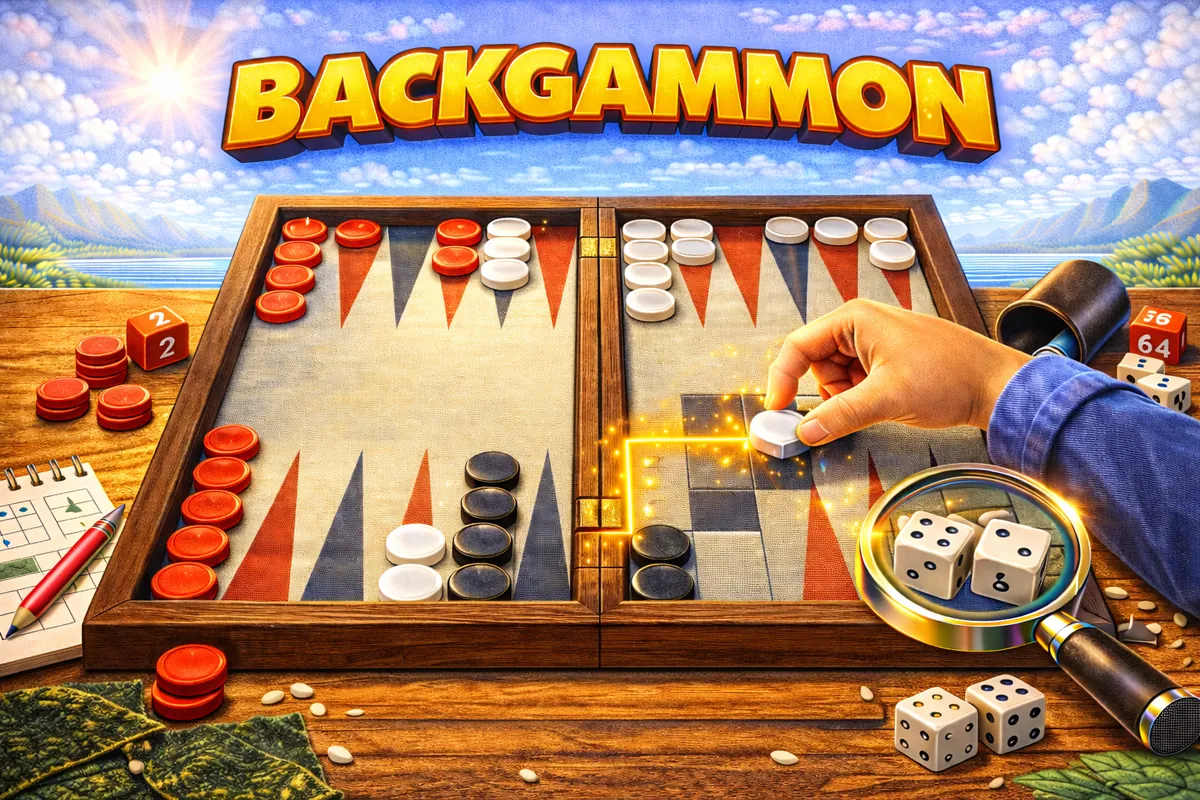
You must play the higher one. In the position above, a 6 and a 2 are both individually legal, but Black holds point 2, so whichever you play first the other is stuck. The rules say the 6 is played and the 2 is forfeited. Playing the 2 and throwing away the 6 — which is what most casual players do, because it keeps the checker safer — is not a bad move. It is an illegal one.
This page enforces both rules for you: when you pick up a checker it only offers destinations that belong to a legal complete turn. If a move you expected is not offered, it is because taking it would strand a die you are obliged to play.
Bearing off is not "any big number gets one out"
Once all fifteen of your checkers are in your home board — the last six points — you can start taking them off. An exact roll always works: a 3 bears a checker off point 3. The rule people get wrong is what a larger roll does.
A die bigger than the point only bears off when no checker sits further back. With checkers on 5 and 3, a 6 takes the one off point 5, because nothing is behind it. A 4 does not take one off point 3, because the checker on 5 is still there — the 4 has to be played as a move instead. This is why an awkward straggler on your 5 or 6 point can cost several rolls at the end of a race.
One more trap: a single checker on the bar means you are not "all home", so bearing off stops entirely until it re-enters.
A lone checker is a target
One checker alone on a point is a blot. Land on it and it is hit — sent to the bar, to re-enter at the far end of the board and travel the whole way round again. Two or more checkers on a point cannot be touched at all, which is the single biggest reason to move checkers in pairs.
Hitting is not a rare flourish. Across 300 games of this page's own engine playing itself, 14.2 checkers were hit per game on average. A checker sent back from your opponent's home board loses most of the ground it had made, which is why the pip count can swing violently on a single roll.
The defence is an anchor: two checkers held together on a point in your opponent's territory. It cannot be hit, it gives your checkers somewhere safe to land as they come round, and it stops you being shut out if things go wrong.
The pip count, and when to stop fighting
Your pip count is the total number of points all your checkers still have to travel. At the start of the game it is 167 for each side — the position is exactly symmetrical. Every pip you move reduces it by one; every checker hit adds back the whole distance it had covered.
The count decides what kind of game you should be playing. If you are ahead, you want a race: run for home, avoid contact, take no risks. If you are behind, racing loses by definition, so you need contact — hold an anchor, wait, and hope for a hit. Players lose games they should have won by continuing to fight after they got in front, and lose games they might have saved by racing when they were already behind.
Where the game gets decided
Making points beats moving fast. Two checkers on a new point is almost always worth more than two checkers advanced separately. Points block your opponent and cannot be hit; loose checkers do neither.
The 5 point is the one to want. Your own 5 point and your opponent's are the most valuable on the board. Yours blocks their escape at the tightest place; theirs is the anchor that keeps you alive if you fall behind.
Six points in a row is a prime, and a prime is a wall. No checker can jump six consecutive made points, because the largest die is a 6. Anything trapped behind a full prime stays there until the prime breaks.
Do not leave blots for no reason. Late in the game, when your opponent has checkers behind yours, a blot left within range is the most common way a won position turns into a lost one.
What was verified on this page
The rules engine was tested against an independent implementation written from the rules of backgammon, and it came through completely clean — the second game on this site so far to need no correction at all.
Because backgammon's hardest rules are about the whole turn rather than one move, the comparison was made on complete turns, not individual moves. Every legal turn was enumerated for 2,400 position-and-dice combinations — 191,726 distinct turns in all — and the page's set matched the independent one exactly every time. The must-use-both-dice rule held across 5,923 positions where both were playable, and doubles correctly gave four moves in every position tested.
The higher-die rule needed a different approach. The random positions threw up only one case where it actually bites, which is far too few to call it tested, so the position in the first diagram was constructed deliberately — along with two controls: one where the higher die has no move at all, so the lower one must be played, and one where both dice are playable, so neither may be dropped. All three behaved correctly.
The strongest check is the one that tests everything at once. Checkers in backgammon are never created or destroyed: each side always has exactly fifteen, counting the board, the bar and the ones borne off. Across 200 complete games, that count was verified after every half-move — a duplicated checker, a hit that failed to reach the bar, or a bear-off that left the checker behind would all break it immediately. It never broke, and all 200 games reached a finish.
| Measurement | Result |
|---|---|
| Turns per game | 72 (35–188) |
| Checkers hit per game | 14.2 |
| Games where the loser bore off nothing | 42% |
| Winning margin, in checkers | 13 |
| Won by the side moving first | 45% |
The AI is quick: choosing a turn took at most 5 milliseconds, even on doubles, where up to 100 distinct turns had to be enumerated and scored. The three settings are genuinely different opponents — Easy takes a random legal turn and lands on its own best choice only 9% of the time, while Medium and Hard evaluate every turn and always take their best. Hard weighs blot exposure and primes that Medium ignores, and the two picked different turns in 45 of 114 shared positions.
Two things this version leaves out
There is no doubling cube. In match play the cube is most of the skill: either player may offer to double the stakes, and the opponent must accept or forfeit at the current value. Judging when to double and when to drop is a discipline of its own. This page plays single games without it. (The page's own search description used to claim a doubling cube; it does not have one, and that claim has been corrected.)
A win is scored as a win. Real backgammon counts a gammon double when the loser has borne off nothing, and a backgammon triple when the loser also still has a checker on the bar or in the winner's home board. Those are not rare: in the 300 games measured above, 42% ended with the loser shut out entirely and 9.7% would have counted as backgammons. On a real scoresheet, that changes the value of a great many games.
Five thousand years, give or take
Backgammon's ancestors are among the oldest known board games. Boards recognisably like it were excavated at Shahr-e Sukhteh in Iran and dated to roughly 3000 BC, and the Roman game tabula — close enough that a modern player could sit down to it — was popular enough that the emperor Claudius is said to have written a book about it.
The doubling cube, the one piece of the modern game that is genuinely recent, was introduced in New York in the 1920s. It transformed backgammon from a dice game into a gambling game with real decision-making, and it is the reason the game still has a serious competitive scene. Unlike chess or draughts, backgammon will never be solved: the dice mean there is no single best line, only better and worse odds.
More Puzzle & Strategy Games
If you enjoy Backgammon, try these other free games on our site: