Play Queens Puzzle Online
Place exactly one queen in each row, column, and colored region — no two queens may touch, not even diagonally. Pure logic, zero guesswork.
Created by Brian Hamilton
Tap to mark X, tap again for queen
How to play Queens
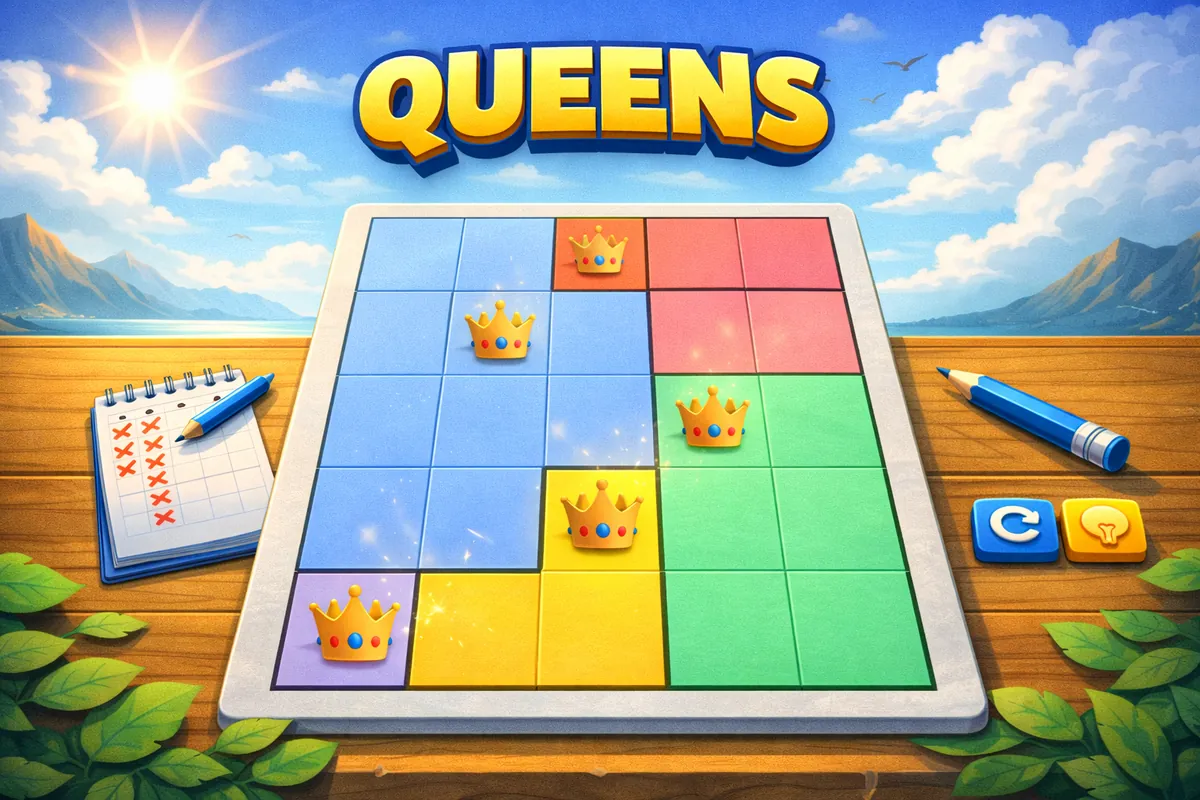
Place crowns on the grid so that every row, every column and every coloured region contains exactly the same number of them.
- On the standard mode that means one crown per row, one per column and one per region.
- No two crowns may touch — not side by side, and not diagonally.
- Crowns are not chess queens. Two crowns may share a diagonal provided they are not immediate neighbours.
- Every puzzle has exactly one solution and never needs a guess.
Controls: click a square once to mark it off with an X, and again to place a crown. A third click clears it. Undo steps back, Solution reveals the answer.
These are not chess queens
The name does more damage than any other single thing about this puzzle. A chess queen attacks along the entire diagonal, so players arrive expecting that rule, rule out perfectly legal squares, and conclude the puzzle is impossible.
Here a crown only objects to its immediate neighbours. Two crowns may sit on the same diagonal quite happily, as long as they are not next to each other.
The difference is not a technicality. On an 8×8 board there are 5,242 ways to place eight crowns under the Queens rules, against 92 arrangements of eight non-attacking chess queens. Fifty-seven times as many — and 98% of legal Queens positions would be illegal as chess queens. If you are applying chess rules you are discarding almost the entire board.
| Board | Queens rules | Chess queens | Ratio |
|---|---|---|---|
| 5×5 | 14 | 10 | 1.4× |
| 6×6 | 90 | 4 | 22.5× |
| 7×7 | 646 | 40 | 16.1× |
| 8×8 | 5,242 | 92 | 57.0× |
| 9×9 | 47,622 | 352 | 135.3× |
What a crown actually forbids
Stated precisely, and it is worth committing to memory because everything else follows from it:
There is a neater way to hold the adjacency rule in your head. Because exactly one crown goes in each row, the only question is how far apart two crowns in consecutive rows sit. The answer is that their columns must differ by at least two. Rows that are further apart place no constraint on each other at all beyond the shared-column rule.
On an 8×8 board there are 64 ways to pick columns for two crowns in adjacent rows. 42 are legal and 22 are not — the 8 that share a column, and the 14 that land one column apart. For two crowns two or more rows apart, all 56 different-column pairs are fine.
The regions are the puzzle
Strip the colours away and the rules alone leave thousands of possible answers on an 8×8 board. Every one of those five thousand-odd arrangements satisfies row, column and adjacency perfectly. The regions are what cut it down to exactly one.
That has a practical consequence. When you are stuck, the productive question is almost never “where can a crown go in this row?” — there are usually several answers. It is “which region has the fewest squares left?” A region confined to two or three squares is doing more work for you than an entire row.
Look for regions that are long and thin, or that sit mostly inside a single row or column. A region entirely contained within one row means that row’s crown must be in that region, which immediately frees every other region from that row.
Two eliminations that do most of the work
- A region inside one row or column claims it. If every square of a region lies in row 4, then row 4’s crown belongs to that region. Every other region can be crossed out of row 4 entirely — and since each region gets exactly one crown, that often strands other regions into a single square.
- Placing a crown shrinks its diagonal neighbours, not the whole diagonal. After each placement, cross off the row, the column, the region, and the (at most) eight touching squares. Resist the urge to sweep the diagonals. That single habit is the difference between the puzzle being solvable and appearing broken.
A worked opening
Here is a 7×7 board, straight out of the generator on this page. Seven regions, seven crowns, exactly one solution.
The first crown is not a deduction so much as an observation. On an untouched board nothing has been eliminated yet, so the only way a region can be down to one legal square is if it is one square. That is where every easy puzzle opens, and it is why hunting for the smallest region is the right first move rather than a stylistic preference.
Across 500 generated 7×7 easy puzzles, 97% contained a single-square region — and in every single one of those it was the opening move. The remaining 3% had a smallest region of two squares, and on those nothing at all was forced from the start. If a board seems to have no way in, check the region sizes before you assume you have missed something.
So the crown for the ringed region goes in at row 4, column 7. Now the second rule earns its keep: cross off that crown’s row, its column, its region and the squares touching it, and do the same after each placement. Three crowns in, the board looks like this.
Every remaining crown falls out the same way. What is worth watching is the order, and how many squares each region still had when it collapsed.
| # | Region size | Crown at | What ruled out the rest |
|---|---|---|---|
| 1 | 1 | r4 c7 | nothing — the region is one square |
| 2 | 2 | r3 c1 | 1 by row |
| 3 | 4 | r2 c3 | 1 by row, 1 by column, 1 by adjacency |
| 4 | 5 | r5 c2 | 2 by row, 2 by column |
| 5 | 4 | r7 c6 | 1 by row, 2 by column |
| 6 | 16 | r1 c5 | 9 by row, 5 by column, 1 by adjacency |
| 7 | 17 | r6 c4 | 11 by row, 5 by column |
Read the size column top to bottom: 1, 2, 4, 5, 4, 16, 17. The two sprawling regions that dominate the board visually are the last two to be resolved, and they are resolved by everything else having already happened. Time spent staring at them early is time wasted.
One honest caveat: of those same 500 easy puzzles, only 44% ran all the way to the end on this kind of single-constraint elimination alone. The rest need at least one step where you combine two regions, or notice that a region confined to one row locks that row. Easy means the opening is generous, not that the whole puzzle is mechanical.
Where solvers get stuck
Applying chess rules by reflex. The commonest failure by a wide margin, and the hardest to notice because the board still looks consistent — you simply run out of squares and assume you made an error earlier.
Working row by row instead of region by region. Rows are numerous and weakly constrained; regions are few and often tight. Scanning the regions in order of size finds forced crowns far faster than scanning rows in order of number.
Forgetting that a crossed-off square still belongs to its region. Eliminating squares is how a region gets narrowed down to one. Marking eliminations properly is not bookkeeping, it is the solving method.
Two things you can check about these puzzles
Every puzzle has exactly one solution, and that is verified rather than assumed. Each candidate board is handed to a solver that counts arrangements and discards anything that does not come back with precisely one. Random colourings are nowhere near good enough for this — in a sample of 300 boards built by growing regions outward at random, not a single one produced a unique puzzle, and the average was around forty valid answers. The region layouts here are constructed deliberately and then checked.
Difficulty is measured in forced moves, and you can count them. Before a puzzle is offered, the generator works out how many of its crowns can be placed by direct elimination with no lookahead. On Easy at least two-thirds of the crowns are forced that way; on Medium between roughly a third and two-thirds; on Hard fewer than a third, so most of the board has to come from interactions between regions. Play one of each at the same size and count how many crowns you place without pausing — the difference is the difficulty setting, not your mood.
Queens, N-Queens and the crown count
The classic N-Queens problem — place N chess queens on an N×N board so none attacks another — is a different puzzle with a long mathematical history, and it has no coloured regions. This puzzle borrows its shape and relaxes its diagonal rule.
You will also see this style called Crowns or simply Queens after the version popularised as a daily puzzle. The multi-crown modes here extend the same idea: with two or three crowns per region the row and column rules scale accordingly, but the adjacency rule is unchanged — no two crowns may touch, on any board, in any mode.
More logic puzzles
If you like placing pieces under constraints, these work the same muscle: