Play Hashi (Bridges) Online
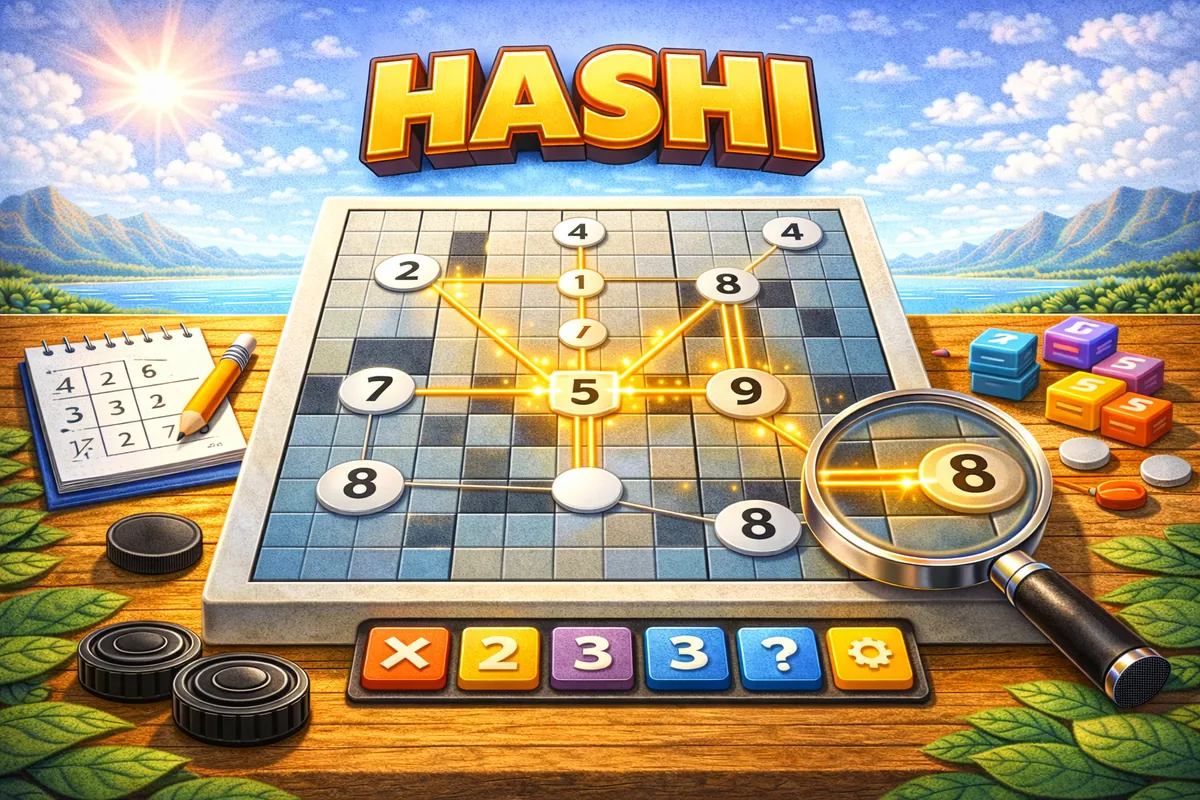
Connect numbered islands with horizontal or vertical bridges. Each island’s number shows how many bridges connect to it. All islands must link into one group.
Created by Brian Hamilton
Click between islands to place bridges
How to play Hashi
Join the numbered islands with bridges. Each island's number is exactly how many bridge ends must touch it.
- Bridges run horizontally or vertically between two islands, never diagonally, and never through a third island.
- At most two bridges between the same pair, and no bridge may cross another.
- When you are done, every island must be reachable from every other — one connected group.
- Every puzzle has exactly one solution.
Controls: click between two islands to place a bridge, again for a double, and a third time to remove it.
Most islands can only reach two others
Hashi looks open. A grid, some numbered circles, bridges anywhere you like. In practice it is far more constrained than it appears, and the reason is worth measuring.
An island can only connect to islands it lines up with along a row or column, with nothing in between. Across 108 generated boards and 1,744 islands, here is how many other islands each one could actually reach:
| Islands it can reach | 1 | 2 | 3 | 4 |
|---|---|---|---|---|
| Share of islands | 4% | 49% | 38% | 9% |
| Most bridges possible | 2 | 4 | 6 | 8 |
Half of all islands can only reach two others, which caps them at four bridges. Only 9% have all four directions available. The board is much tighter than it looks — and that is what makes it solvable.
The rule that opens almost every board
Once you know an island's ceiling, its number tells you a great deal. Two rules follow immediately, and between them they crack nearly every puzzle open.
At the ceiling. If an island's number is exactly twice the islands it can reach, every one of those spans must be a double bridge. There is no other way to reach the total.
One short of the ceiling. If the number is one below twice its reach, then every direction must carry at least one bridge. Drop any direction entirely and the remaining ones cap out one short of the total.
That second rule is the workhorse. It does not finish a span, but a single bridge in every direction is often enough to start a chain of consequences.
Measured over those 108 boards: about 1.4 islands per board sit exactly at their ceiling and 3.4 sit one below it. 94% of boards offer at least one of these openings before you have drawn a single bridge.
The reason they bite so often is the table above. Half of all islands are capped at four, and 3s and 4s together are 47% of every number on the board — so a large share of islands start at or just below their limit.
| Number | 1 | 2 | 3 | 4 | 5 | 6 | 7 |
|---|---|---|---|---|---|---|---|
| Share | 5.7% | 41.1% | 31.9% | 15.1% | 4.8% | 1.1% | 0.2% |
A worked board
Where solvers get stuck
Forgetting the connectivity rule until the end. Every island must end up in one group. That is not just a finishing condition — it is a solving tool. If a bridge would seal off a small set of islands whose numbers are already satisfied, that bridge is wrong, even when the arithmetic works.
Ignoring what a bridge blocks. Bridges cannot cross, so drawing one removes options elsewhere. A span you place across the middle of the board can be the deduction that settles two islands nowhere near it.
Treating a 1 as easy. A 1 is the least informative island on the board: it connects to exactly one neighbour, and usually several are possible. They are only 5.7% of islands, and they are the last thing to resolve, not the first.
Two things you can check about these puzzles
Every puzzle has exactly one solution. The board is grown from a single island, each new one attached to one already placed, so the map is connected by construction. Extra bridges are then added one at a time, and each is kept only if a solver confirms the puzzle still has a single solution. 60 boards across every size and difficulty were re-checked against a separate counter written from the rules alone; all 60 were unique.
Difficulty is island count and double-bridge density. A 7×7 Easy board carries about 9 islands with 19% of spans doubled; 13×13 Hard carries about 26 with 33% doubled. More doubles means higher numbers, which means more islands sitting at their ceiling — so harder boards actually offer more forced openings, but far more board to work through afterwards.
Hashi, Hashiwokakero and Bridges
The puzzle is Hashiwokakero — Japanese for “build bridges” — usually shortened to Hashi, and published in English as Bridges or Chopsticks. It was popularised by Nikoli, the house behind Sudoku and Slitherlink.
It is one of the few pencil puzzles built on a graph rather than a grid: the squares only matter for deciding what lines up with what. If that appeals, Numberlink and Slitherlink are the closest relatives here — both are about drawing paths under constraints rather than filling cells.
More connection puzzles
If you like joining things up under constraints, try these: