Play Kakuro Online
Fill every run of white cells so the digits sum to the clue — using only 1–9 with no repeats per run. A mathematical crossword you can solve with pure logic.
Created by Brian Hamilton
Tap a white cell, then enter a digit
How to play Kakuro
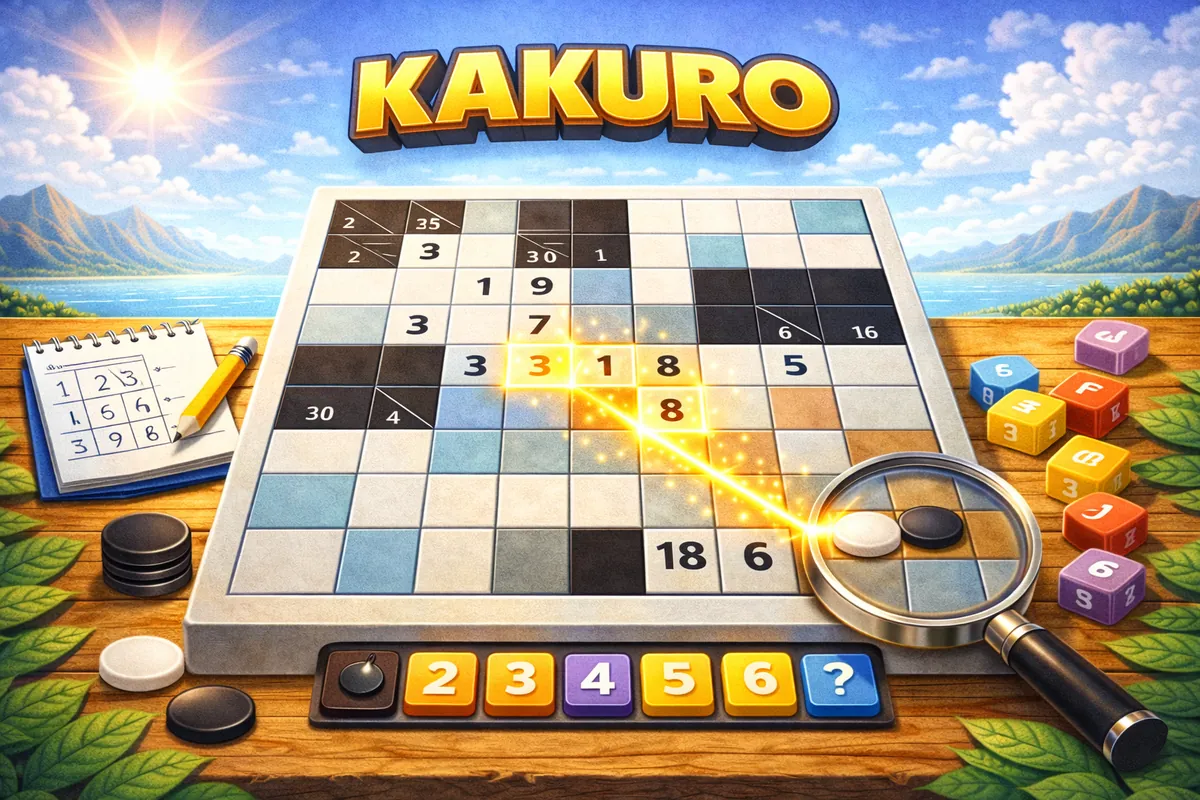
Fill every white square with a digit from 1 to 9 so that each run adds up to its clue.
- A clue in the top-right of a black square is the total of the white squares running to its right; a clue in the bottom-left is the total of the squares running downwards.
- No digit may repeat within a single run. The same digit can appear twice in a row or column if the two squares belong to different runs.
- Zero is never used.
Controls: tap a white square and type or tap a digit. Notes lets you pencil in several candidates at once, which is the way most Kakuro is actually solved. Hint fills one empty square.
Thirty-four clues give away their digits completely
A Kakuro clue tells you a total. What makes the puzzle tractable is that for certain totals, the set of digits is forced — there is only one way to make that sum from that many different digits, so you know exactly which numbers go in the run before you know their order.
There are 120 possible combinations of run length and total in Kakuro. Of those, 34 are pinned to a single set of digits. Those 34 are the ones worth knowing, and the pattern behind them is easy to remember: for every run length, the two smallest totals and the two largest are always pinned.
| Cells | Total | The only possible digits |
|---|---|---|
| 2 | 3 | 1 2 |
| 4 | 1 3 | |
| 16 | 7 9 | |
| 17 | 8 9 | |
| 3 | 6 | 1 2 3 |
| 7 | 1 2 4 | |
| 23 | 6 8 9 | |
| 24 | 7 8 9 | |
| 4 | 10 | 1 2 3 4 |
| 11 | 1 2 3 5 | |
| 29 | 5 7 8 9 | |
| 30 | 6 7 8 9 | |
| 5 | 15 | 1 2 3 4 5 |
| 16 | 1 2 3 4 6 | |
| 34 | 4 6 7 8 9 | |
| 35 | 5 6 7 8 9 | |
| 6 | 21 | 1 2 3 4 5 6 |
| 22 | 1 2 3 4 5 7 | |
| 38 | 3 5 6 7 8 9 | |
| 39 | 4 5 6 7 8 9 |
The reason is arithmetic rather than magic. The smallest total a run of k different digits can reach is 1+2+…+k, and there is exactly one way to hit it. The next total up is reached by nudging the largest digit up by one — again only one way. The same argument runs downward from the maximum, 9+8+…
The practical version: a clue near the extremes of its range is worth far more than a clue in the middle. Two cells adding to 9 have four possible pairs and tell you almost nothing. Two cells adding to 17 have exactly one.
| Cells | Worst total | Possible digit sets |
|---|---|---|
| 2 | 9 | 4 |
| 3 | 14 | 8 |
| 4 | 20 | 12 |
| 5 | 25 | 12 |
Crossings are where the puzzle is actually solved
Knowing a run's digit set does not tell you the order. What does is the run crossing it: a white square belongs to one across run and one down run at once, and it can only hold a digit that both of them allow.
Work the two clues separately. Four cells adding to 11 is one of the pinned totals — it can only be 1 2 3 5. Two cells adding to 13 is not pinned; it could be 4+9, 5+8 or 6+7, so its square holds one of 4, 5, 6, 7, 8, 9.
Now intersect them. The across run allows {1, 2, 3, 5}. The down run allows {4, 5, 6, 7, 8, 9}. Only 5 appears in both, so that square is a 5 — and neither clue could have told you that on its own.
That is the whole method, and it is why writing candidate digits in the corners of squares is not optional bookkeeping in Kakuro — it is the technique. A square with one candidate left is solved; a run with one arrangement left solves several at once.
Where solvers get stuck
Adding instead of eliminating. The instinct is to look for a total you can make. The faster route is to ask which digits are impossible. A 2-cell clue of 16 bans seven of the nine digits immediately; that is far more information than any digit you might place.
Ignoring the no-repeats rule inside a run. It is what makes the combination table finite. Four cells summing to 11 have plenty of solutions if repeats are allowed; with distinct digits there is exactly one set.
Starting with the longest run. Long runs in the middle of their range are the least informative clues on the board. Start with 2-cell and 3-cell runs near the extremes, and let their digits propagate outward.
Two things you can check about these puzzles
No run is ever one square long, and none is longer than five. The board pattern is built by a search that enforces both bounds as it lays the black squares out: a run of one would hand you its digit for free, and very long runs carry almost no information. On the 6×6 boards no run exceeds four squares; on 8×8 and 10×10 the cap is five. Count the white squares in the longest row you can find — it will not beat that.
You are marked on the rules, not on a stored answer. The win check tests whether every run adds to its clue with no repeated digit, rather than comparing your grid against the solution the generator happened to produce.
That matters because only the 6×6 boards are guaranteed to have a single answer — those are generated by retrying until a solver confirms exactly one filling exists, which is why they carry more black squares than you might expect. On 8×8 and 10×10 a board can admit more than one valid filling, and on those any correct answer is accepted rather than only the one the generator had in mind. The Hint button fills an empty square in preference to overwriting one you have already entered, for the same reason.
Kakuro, Cross Sums and Kakkuro
Kakuro is short for the Japanese kasan kurosu, “addition cross”. In English-language puzzle books it appeared for decades as Cross Sums, and you will also see Kakkuro and Cross Addition. The modern form was popularised by Nikoli, which is where the Japanese name comes from.
It is often described as a numerical crossword, and the analogy is a good one: clues run across and down, entries share squares, and the crossings do the work. The difference from Sudoku is that Kakuro's constraint is arithmetic — a total to hit — rather than pure placement.
More number puzzles
If you like arithmetic constraints doing the deducing, try these: