Play Minesweeper Online
Uncover every safe cell without hitting a mine. Use the number clues to deduce where mines are hidden, then flag them. Three mobile-friendly grid sizes — from quick games to serious challenges.
Created by Brian Hamilton
How to play Minesweeper
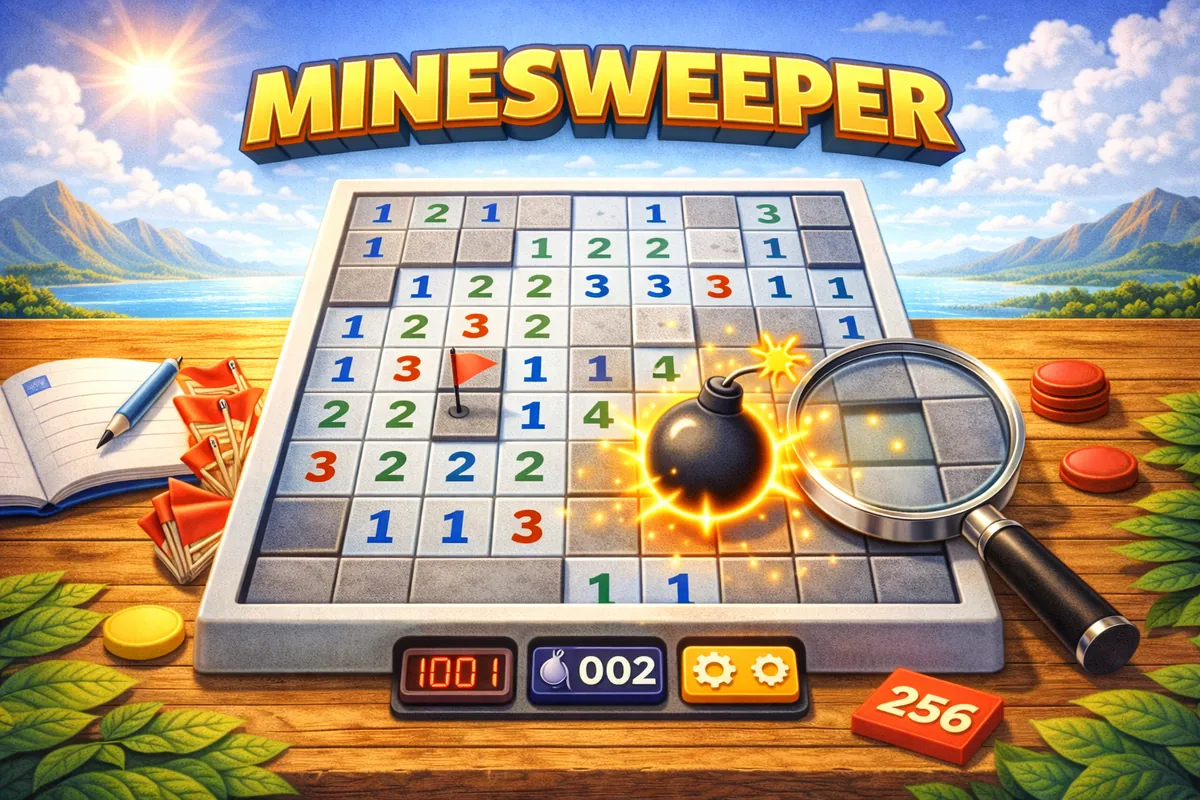
Reveal every square that is not a mine. Each revealed square shows how many of the eight squares around it are mines.
- Your first click is always safe and always opens an area — mines are placed after you click.
- Flag a square to mark it as a mine. Flags are bookkeeping only; you win by revealing safe squares.
- Every board can be finished by logic alone — boards that would force a guess are rejected before you see them.
Controls: tap to reveal, long-press or right-click to flag. Tapping a number with all its mines flagged clears the rest of its neighbours.
Tap to reveal · Long-press to flag · Or use Flag Mode button
The guess that was never your fault
Everyone who has played Minesweeper has lost a board they were solving perfectly. Fifty squares cleared, three flags placed, and then a position where two squares are equally likely to be a mine and nothing on the board can tell you which. You pick one. You are wrong.
That is not a lapse in your reasoning. It is a flaw in how the board was built — and it used to happen here far more often than most players would guess.
How often it really happened
To measure this properly you need a solver that is exhaustive. It is not enough to apply the usual patterns and give up; you have to enumerate every arrangement of mines consistent with every visible number, and only call a position ambiguous when no square is safe in all of them. Anything less measures the solver, not the board.
We built that solver and played out 400 boards per difficulty.
| Difficulty | Grid | Mine density | Never needed a guess |
|---|---|---|---|
| Small | 9×9, 10 | 12.3% | 90% |
| Medium | 12×12, 25 | 17.4% | 54% |
| Large | 16×16, 40 | 15.6% | 67% |
Nearly half of all Medium boards were unwinnable by logic alone. Not unwinnable — you could still get lucky — but no player, however good, could have reasoned their way through.
Look at the order in that table. Medium was harder than Large, even though Large has a bigger grid and more mines. Difficulty here never tracked board size; it tracked density, and at 17.4% Medium was the densest of the three. A denser board means numbers that constrain less, which means more positions where the evidence simply runs out.
And when a guess was forced, it was usually not a clean 50/50. Taking the best available odds each time, the luckiest legal guess was safe about 79% of the time — but roughly 30% of forced guesses were near coin-flips, between 45% and 55%. So guessing well is a real skill, and sometimes there is no skill available at all.
What we changed
Mines are placed on your first click, so that click is always safe. That much was already true. What has changed is what happens next: the board is now played out by the solver before you ever see it, and if it reaches a position needing a guess, the mines are scattered again and it tries once more.
Every board now solvable by pure logic, verified on 900 fresh boards with an independent solver: 900 of 900, on all three difficulties. It costs on average 1.1 to 1.8 attempts and under 10 milliseconds — you will not notice it happening.
This changes what a loss means. If you hit a mine now, the information you needed was on the board and you moved too quickly. That is a fair game in a way the old one was not.
The pattern worth memorising
Since every board is now solvable, it is worth knowing the deduction that appears most often.
Three squares reading 1, 2, 1 along a row, with three hidden squares above them. The middle square needs two mines among those three, and each 1 needs exactly one. If a mine sat above the 2, both 1s would be satisfied by it and the 2 would need a second mine from the two remaining outer squares — which would give one of the 1s a second mine. So the mines go at the ends, and the middle square is safe every time.
The general habit behind it: when two numbers overlap, compare what each requires. If one number's hidden squares are a subset of another's, the difference between the two counts tells you exactly what is in the squares that are not shared. Most of the reasoning beyond the obvious comes from that one idea.
Where players go wrong
Flagging everything. Flags are only bookkeeping — the game is won by revealing safe squares, not by placing flags. Time spent flagging a mine you have already identified is time not spent finding the next safe square.
Working the wall instead of the corners. An edge square has five neighbours and a corner has three, so the same number is far more constraining there. Edges and corners are where the certain deductions live.
Ignoring the mine counter. Near the end, the number of mines left is itself a constraint on the whole board, and it will often settle a group that the local numbers alone cannot.
Two things you can check about this game
Your first click is always safe, and always opens a space. Mines are placed after you click, and the clicked square and all eight of its neighbours are excluded — so that square necessarily shows a zero and cascades open. You never lose on move one, and you never start with a bare number.
Every board can be finished by reasoning. Boards are solver-tested before you see them and re-scattered if a guess would be needed. Verified at 900 out of 900 across all three sizes.
A puzzle older than Windows
Minesweeper predates its famous Windows 3.1 outing. Its ancestors are 1970s mainframe games like Cube and Mined-Out (1983), and Microsoft's version was written by Robert Donner and Curt Johnson in 1990. It shipped with Windows for fifteen years, teaching a generation to use a mouse's right button.
It also has a serious side. Deciding whether an arbitrary Minesweeper position is consistent is NP-complete, shown by Richard Kaye in 2000 — which is why the solver behind these boards has to enumerate rather than pattern-match, and why generating a guaranteed-solvable board takes real work.
More logic puzzles
If you like deducing hidden information from numbers, try these: