Play Nurikabe Online
Shade cells to build a connected sea. Each numbered cell anchors a white island of that size. No 2×2 pools allowed!
Created by Brian Hamilton
Tap a cell to shade it (sea) — tap again to mark white (island)
How to play Nurikabe
Shade squares to make the sea. Every numbered square is an island of exactly that many unshaded squares.
- Each island holds exactly one number, and no two islands may touch edge to edge.
- The sea must be one connected region.
- No 2×2 block may be entirely sea.
- Every puzzle can be finished by logic alone — no guessing.
Controls: tap a square to shade it as sea, tap again to mark it white, and a third time to clear it.
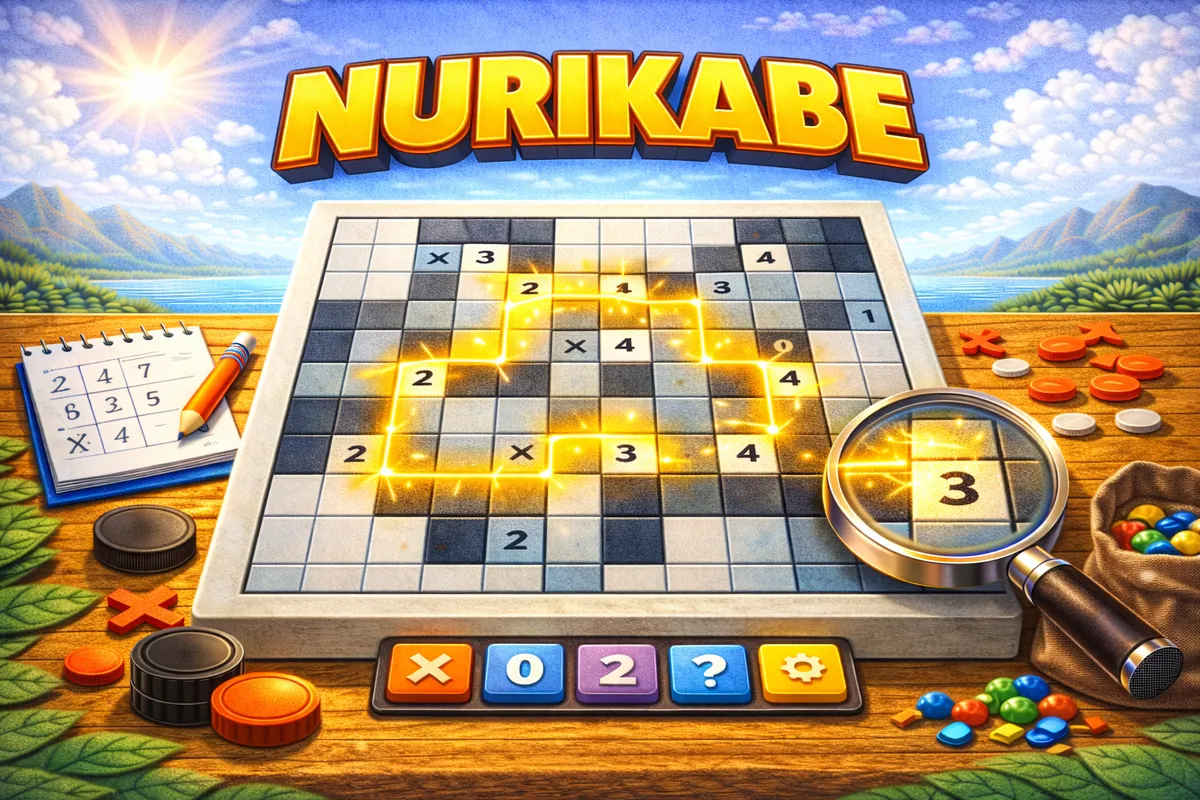
Two openings that need no reasoning at all
Nurikabe looks like it should be hard to start. A grid, a scattering of numbers, and three rules that all seem to depend on each other: every number is an island of exactly that many white squares, no two islands touch, the shaded sea is one connected region, and no 2×2 block is entirely sea.
In fact two openings are available on essentially every board, and neither requires any thought.
Those two rules are worth internalising because of how common they are. Across 36 generated boards, 39% of all clues were 1s — each one instantly shading four squares — and every single board had at least one square wedged between two clues, with about 7 such squares per board.
| Clue | 1 | 2 | 3 | 4 | 5 | 6 |
|---|---|---|---|---|---|---|
| Share | 38.6% | 28.3% | 18.3% | 10.7% | 3.1% | 1.1% |
The rule that does the real work
The no-2×2 rule is the one that looks arbitrary and turns out to carry the puzzle. It cuts both ways, and the second direction is the one people miss.
Forwards, it stops you shading: three sea squares in an L shape mean the fourth square of that block cannot be sea, so it is white — and now some island has to reach it. That is often how you discover where a large island must run.
Backwards, it constrains the sea's shape everywhere at once. The sea has to be one connected region covering roughly 63% of the grid while never being two squares thick in both directions. That forces it into long, winding, one-square-wide channels, and a channel with only one way forward is a forced move.
Between them, the direct rules — finished islands, squares between clues, squares no island can reach, and the 2×2 rule — settle about 70% of the board before you have to think about anything harder.
A worked board
Start with the two 1s — eight squares of sea for free. Then look along the edges: an island near a wall has fewer directions to grow, so a 4 or 5 in a corner is far more constrained than the same number in open space.
Where solvers get stuck
Growing an island without checking it can still finish. Before extending an island, ask whether the remaining squares can still reach its total. An island of 5 that has claimed 3 squares and boxed itself into a dead end is a mistake made several moves ago.
Forgetting the sea has to stay connected. Shading a square that seals off a pocket of sea is wrong even when every number still works. Connectivity is a solving tool, not just a finishing condition — a sea region with one way out must take it.
Not marking squares as definitely white. Nurikabe has three states, not two: sea, island, and unknown. Solvers who only shade lose track of what they have already ruled out. Marking a square white is a real deduction and worth recording.
Two things you can check about these puzzles
Every puzzle can be finished by pure logic. Boards are not merely tested for having one solution — each is played out by a solver that makes only forced moves, and shipped only if that solver finishes it. That is the stronger guarantee: it means the board can actually be reasoned out rather than merely having a unique answer somewhere. Boards across every size and difficulty were then re-checked against a separate, exhaustive solution counter, and every one it could evaluate had exactly one solution.
Generation searches for the best board it can find. Rather than shipping the first acceptable layout, the generator keeps looking for a few seconds and keeps the one with the largest average island — which is why a progress bar appears. On a 7×7 that lifts the average island from about 1.7 squares to 2.6, and the share of clues that are a bare 1 falls from two-thirds to under 40%.
It is also why the grids stop at 10×10. Nurikabe resists random generation in a way most grid puzzles do not: on a 10×10, none of 113 randomly built layouts with decent island sizes turned out to have a unique solution, and merely checking one takes a minute and a half. Bigger grids can be filled with tiny one-square islands and verified easily, but that is a pattern rather than a puzzle. Two sizes that are worth solving beat three where the largest is filler.
Nurikabe, and what the name means
Nurikabe is a yōkai from Japanese folklore — an invisible wall that blocks a traveller's path at night, which is a fair description of the sea closing off a route you needed. The puzzle was published by Nikoli, the house behind Sudoku and Slitherlink, and also appears as Islands in the Stream or Cell Structure.
It sits in the shading family alongside Norinori and Heyawake. Norinori has no connectivity rule at all, which makes it the gentler introduction; Nurikabe's connected-sea requirement is what gives it its particular character, and its difficulty.
More shading puzzles
If you like deciding which squares to fill in, try these: