Play Norinori Online
Shade exactly two cells in every region so that every shaded cell is part of a domino — a pair of orthogonally adjacent shaded cells. Dominoes may span two regions!
Created by Brian Hamilton
Tap a cell to shade it — tap again to unshade
How to play Norinori
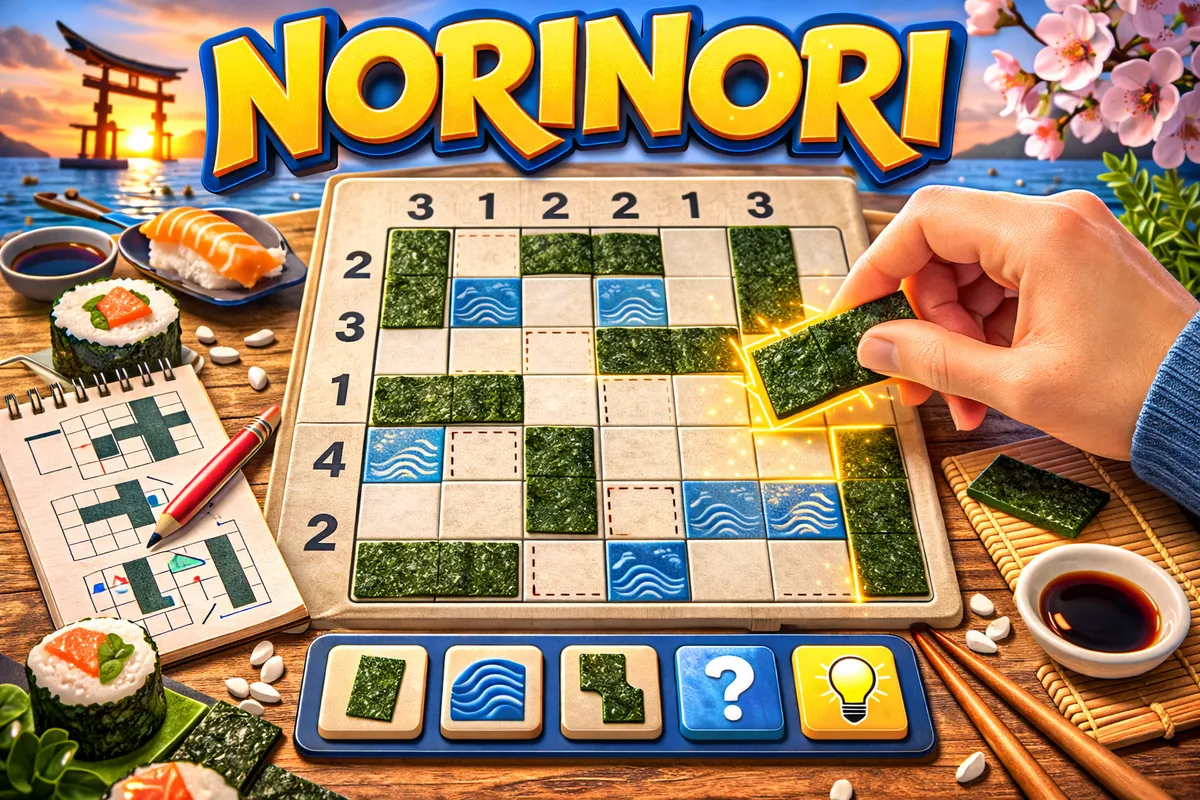
Shade squares so that every region holds exactly two shaded squares, and the shaded squares across the board pair off into dominoes.
- A domino is two shaded squares touching edge to edge. Every shaded square must touch exactly one other shaded square.
- Dominoes may cross region boundaries — a region's two shaded squares need not be a domino between them.
- Three shaded squares in a line is never allowed.
- Every puzzle has exactly one solution.
Controls: tap a square to shade it, tap again to mark it as definitely empty, and a third time to clear it.
Every two-square region is a free move
Norinori looks forbidding. You must shade exactly two squares in every region, and the shaded squares across the whole board have to pair off into dominoes — pairs that touch edge to edge, with no shaded square left over and none touching two others. Nothing on a fresh grid looks like a starting point.
There is one, and it is completely reliable. Find a region made of exactly two squares. That region needs two shaded squares and it only has two squares, so both are shaded. A region is always connected, so those two squares touch: they are a domino, already finished. And because each of them now has its one permitted shaded neighbour, every other square orthogonally touching the pair must stay empty.
That is not a heuristic that usually works. It follows from the rules with no exceptions, and across 20 generated boards all 43 two-square regions behaved exactly this way: both squares shaded, every orthogonal neighbour empty. It is the single best opening move in the puzzle, and two-square regions are common — about one region in five.
| Squares in region | 2 | 3 | 4 | 5 | 6 | 7 | 8 | 9 | 10+ |
|---|---|---|---|---|---|---|---|---|---|
| Regions | 43 | 50 | 37 | 20 | 14 | 11 | 9 | 13 | 9 |
Three-square regions are the next best thing. Two of the three squares are shaded, so exactly one is empty — only three cases to test, and in a bent three-square region the middle square is in both possible dominoes, which often settles it immediately.
Why you cannot solve region by region
Here is the part that catches people. The rule “two shaded squares per region” makes it sound as though each region can be worked out on its own. It cannot, because a domino is allowed to straddle a region boundary, and most of the interesting ones do.
Across those same 20 boards, 91 of 206 dominoes — 44% — had their two squares in different regions. Nearly half the dominoes on a board are shared between two regions.
So a region's two shaded squares are frequently not a domino at all. They can be two squares far apart within the region, each paired off with a neighbour on the other side of a border. A region of eight squares might contribute one square to a domino at its top edge and one to a domino at its bottom edge, and never contain a complete domino anywhere.
The practical consequence: when you shade a square near a boundary, always ask which side its partner is on. Both answers constrain a different region, and following that through is where most of the deduction on a hard board comes from.
A worked board
Start with the two two-square regions — both are free dominoes, and each clears its neighbours. Work outward from the empty squares they create: a square that has been ruled out removes a partner option for everything beside it, and in a small region that quickly leaves only one legal pair.
Where solvers get stuck
Shading a third square in a line. Three shaded squares in a row is always wrong — the middle one would touch two others, and a domino is exactly two. Whenever you shade a square next to an existing shaded one, the pair is complete and everything else around both of them is empty.
Forgetting the empty squares are information. Norinori is solved as much by ruling squares out as by shading them in. A large region with most of its squares eliminated becomes as easy as a two-square one. Mark eliminations as you go rather than keeping them in your head.
Treating a big region as hopeless. A nine-square region still holds just two shaded squares, so seven of its nine squares are empty. Big regions are mostly emptiness, and that emptiness constrains their neighbours just as strongly as shading would.
Two things you can check about these puzzles
Every puzzle has exactly one solution. The generator lays out dominoes first, builds regions around them, then runs a solver that counts solutions and stops at two. A layout is only kept once the count comes back as exactly one; otherwise the regions are reshaped and re-tested. Boards at 6×6, 8×8 and 10×10 were checked against a separate solution counter written from the rules alone, and all 23 had a single solution.
Difficulty changes where the boundaries fall, not how many regions there are. A 6×6 board carries about eight regions and an 8×8 about thirteen, and that barely moves between settings. What Hard does is deliberately draw the boundaries through the dominoes, so more of them are shared and fewer regions can be finished on their own.
| Board | Setting | Regions | Dominoes crossing a boundary | Two-square regions |
|---|---|---|---|---|
| 6×6 | Easy | 8.1 | 26% | 31% |
| Medium | 8.3 | 38% | 23% | |
| Hard | 8.1 | 48% | 20% | |
| 8×8 | Easy | 13.1 | 27% | 23% |
| Medium | 13.6 | 43% | 19% | |
| Hard | 13.4 | 61% | 17% |
On an 8×8 Hard board nearly two dominoes in three are shared between regions, and only one region in six is a free two-square opener. That is the whole of the difficulty curve: the rules never change, but the amount you can settle locally does.
Norinori and its relatives
Norinori was published by Nikoli, the Japanese puzzle house behind Sudoku and Slitherlink. The name means roughly “glue-glue”, after the domino pairs.
It belongs to the shading family, but it is unusual in it. Nurikabe and Heyawake both require the shaded or unshaded squares to form one connected mass, and checking connectivity is most of the work. Norinori has no connectivity rule at all — instead every shaded square must have exactly one shaded neighbour, which keeps the reasoning local and makes it a gentler introduction to shading puzzles than its reputation suggests.
More shading puzzles
If you like deciding which squares to fill in, try these: